Mohamed Boumeshoul, founder · Updated November 2026
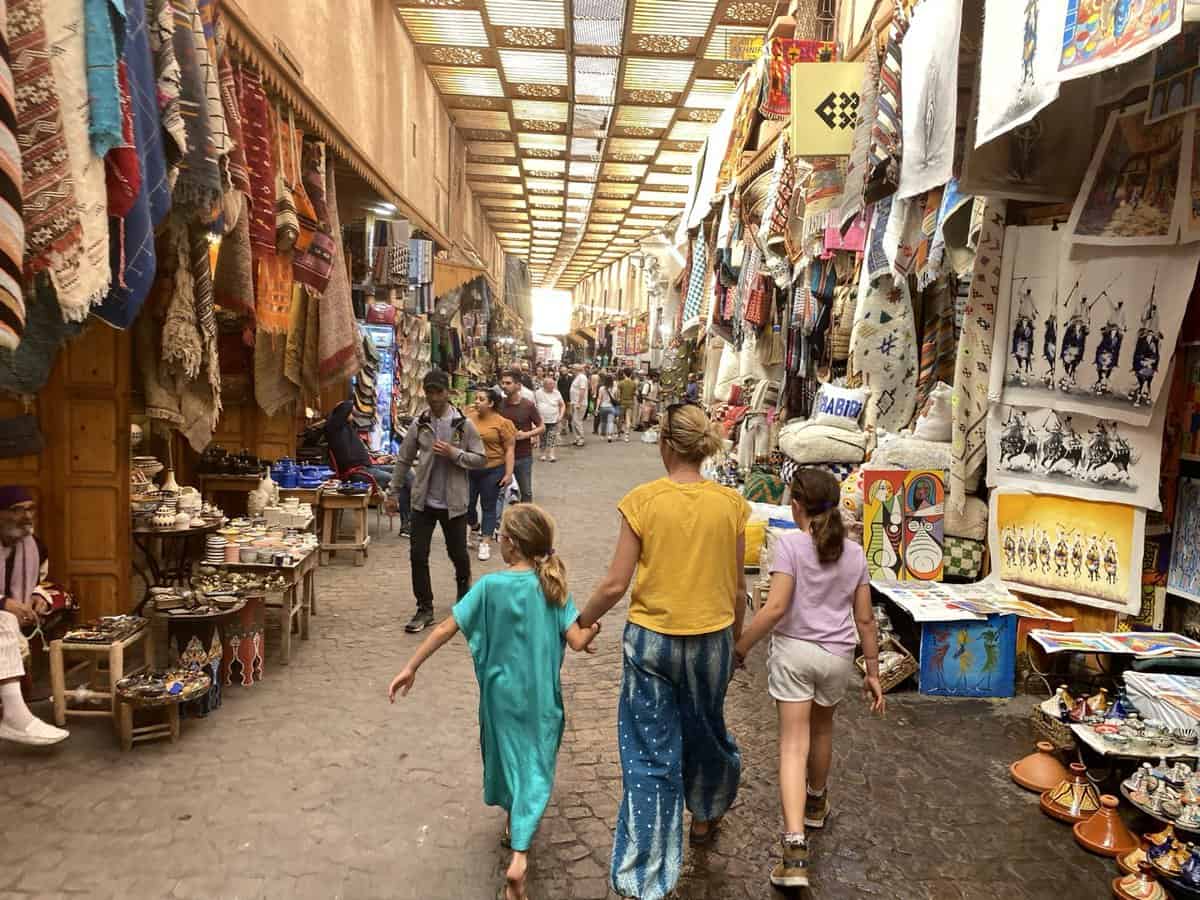
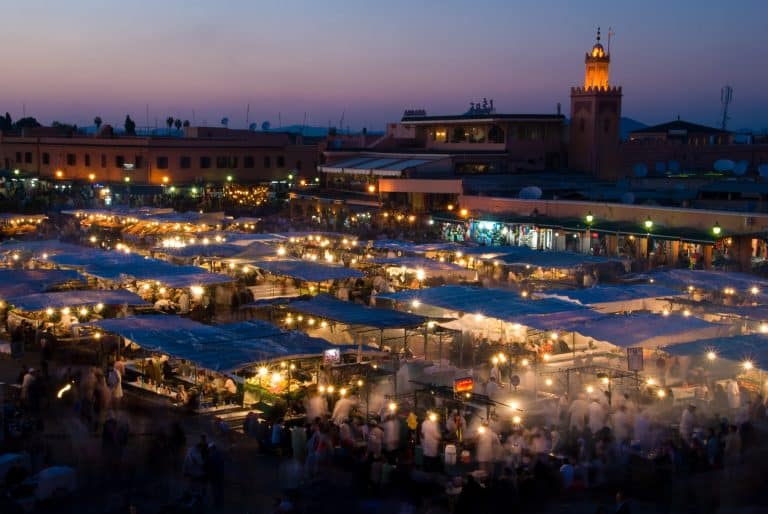
The souks of Marrakech fill the medina just north of Jemaa el-Fna: a maze of covered lanes where every trade has its own street. Leatherworkers in one corner, blacksmiths in another, freshly dyed wool drying over your head in a third. It feels chaotic the first time, but it follows a layout that goes back centuries, and once you see it the souks get much easier to enjoy.
This guide takes you through the main souks roughly in the order you will meet them, with honest tips on buying and bargaining. At the end there are a few markets in other Moroccan cities that are worth a detour.
Last checked: November 2026. Opening hours vary from shop to shop, and many close for a while around Friday midday prayers.
In this guide
How the Marrakech souks are laid out
Start at Jemaa el-Fna and look for the arched entrance on the north side of the square. That is Souk Semmarine, the main covered street. It runs north, turns into Souk el Kebir, and nearly every other souk branches off it. If you get lost, ask anyone for “la place” (Jemaa el-Fna) and they will point you back.
Most shops open from mid-morning until the evening. Mornings are the calmest time to look around. Late afternoon is the busiest and loudest, which is part of the fun.
Souk Semmarine and Souk el Kebir
Souk Semmarine is most visitors’ first taste of a Moroccan souk. It is a wide lane under a tall trellis roof, lined with textiles, clothing, babouche slippers, lanterns, pottery and souvenirs. Because everyone walks through here, prices start high.
At the far end the street forks. The left branch leads to Souk el Attarin, the old spice and perfume souk, and on to Souk Smata, with its walls of babouches in every color. Straight on, the lane becomes Souk el Kebir, with everyday clothing in the covered kissarias and a small jewelers’ lane on the right.
Rahba Kedima, the old square
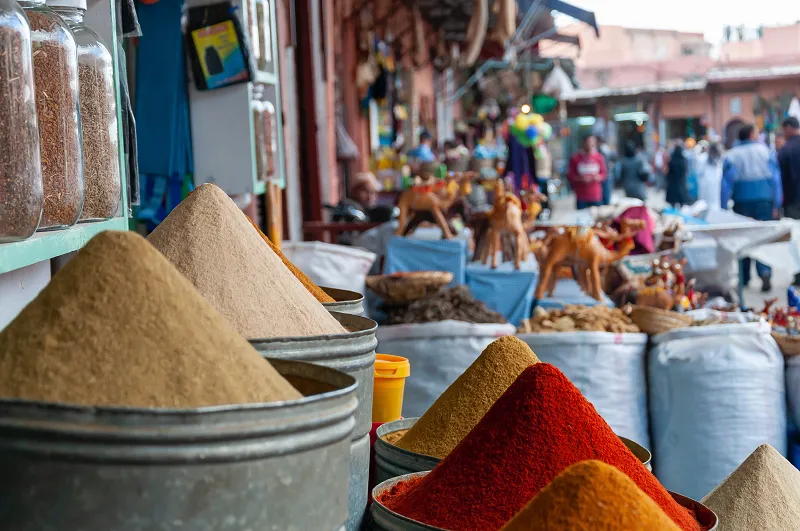
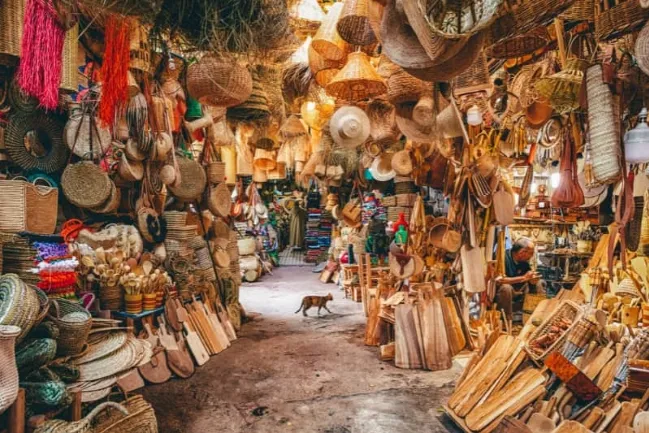
Just before the fork at the end of Semmarine, a narrow lane on the right opens onto Rahba Kedima, a small open square that feels good after the covered streets. Around its edges are the apothecaries, often called Berber pharmacies, selling herbs, henna, argan oil, amber and remedies for just about everything. In the middle, women sell woven baskets and hats.
A few cafés around the square have roof terraces. Climb up for a mint tea and a view over the rooftops toward the Atlas.
In one corner, a passage leads into the Criée Berbère, which is now a carpet market. Before 1912 it was where enslaved people were auctioned, a part of Marrakech’s past that a good guide will talk about honestly if you ask.
Souk Cherratine, the leather souk
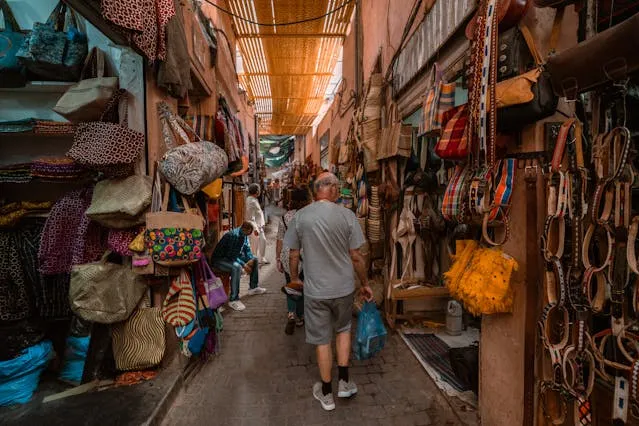
Past the northern end of Souk el Kebir, the lanes of Souk Cherratine belong to the leatherworkers. In tiny workshops, men cut and stitch bags, belts, wallets, sandals and poufs, often selling straight from the bench. It is the best place in the medina to buy leather, because you can watch it being made.
Check the stitching and the smell: good leather smells of leather, not chemicals. The tanneries themselves are farther east, near Bab Debbagh. If a stranger offers to walk you there, say no politely. It nearly always ends in a shop.
Souk Haddadine, the blacksmiths’ souk
You hear Souk Haddadine before you see it. West of Souk Smata, this is the quarter of the blacksmiths and metalworkers, full of hammering, sparks and the smell of hot iron. They make wrought-iron furniture, window grilles, locks and keys, and the pierced metal lanterns that hang all over Marrakech.
It is one of the most authentic corners of the medina, so slow down and watch, and ask before you photograph anyone at work. You can often buy a lantern straight from the workshop that made it.
The dyers’ souk
Souk des Teinturiers, the dyers’ souk (Souk Sebbaghine in Arabic), is the most photographed lane in the medina. Skeins of freshly dyed wool and silk hang overhead to dry in saffron yellow, indigo, deep red and green. It sits on the west side of the souks, toward the Mouassine mosque and its fountain.
Go in the morning, when the dyers are working and the colors are still wet. Some will happily show you how the wool is dipped, and the shops nearby sell scarves dyed in the same lane.
Tips for shopping in the Marrakech souks
- Bargaining is normal for crafts and souvenirs. Start well below the first price, stay friendly, and walk away politely if it doesn’t feel right.
- Prices for food and everyday goods are usually fixed, so there is no need to haggle over a bag of dates.
- Carry cash in small notes. Bigger shops take cards, but many stalls don’t.
- Many shops close for a while around Friday midday prayers.
- If a stranger offers to show you the way, a firm “no, thank you” is fine. A licensed guide saves a lot of time, especially on your first day.
- Ask before photographing people or their stalls.
If you love crafts, our article on Moroccan handicrafts explains what to look for in rugs, pottery and leather. For the rest of the city, see 5 must-see places in Marrakech.
Other souks in Morocco worth a detour
Souk el-Attarine, Fes
In the Fes medina, the old spice and perfume market sits close to the Attarine Madrasa and the Qarawiyyin, a short walk from the Chouara tannery. The Fes medina is a real maze, and this is where a licensed guide earns their fee. Our guide to Fes covers the rest of the old city.
Souk Had Draa, near Essaouira
Had Draa is a village about 25 km inland from Essaouira, and its souk is a country market held on Sundays (“had” means Sunday). Farmers bring vegetables, tools, spices and livestock, and the animal market is the big event of the morning. Arrive early and dress modestly.
Souk El Had, Agadir
Agadir’s big walled market is where locals do their weekly shopping, with produce, spices, clothes and household goods under one roof. It is generally closed on Mondays, so check before you go.
Chefchaouen and Meknes
Chefchaouen’s market around Outa el-Hammam square is small and relaxed, good for woven blankets and local goat cheese (see our Chefchaouen guide). In Meknes, start at the covered food market on Place el-Hedim, then wander the lanes behind it.
Frequently asked questions
What are the main souks in Marrakech?
Souk Semmarine and Souk el Kebir form the main street. Off it are Rahba Kedima, the leather souk (Cherratine), the blacksmiths’ souk (Haddadine), the dyers’ souk, Souk el Attarin for spices and Souk Smata for slippers.
Where do the Marrakech souks start?
On the north side of Jemaa el-Fna. The arched entrance to Souk Semmarine is the easiest way in.
Do I need a guide for the Marrakech souks?
No, but a licensed guide helps a lot on your first visit. They know the shortcuts, explain what you are seeing and keep the hustlers away.
When is the best time to visit the souks?
Weekday mornings are the calmest. Late afternoon is lively and crowded. Many shops close for a while around Friday midday prayers.
Is it safe to shop in the souks?
Yes, generally. Watch your bag in crowds and turn down unofficial guides politely. Our article on whether Marrakech is safe has more.
Related reading
- 5 must-see places in Marrakech
- 10 of the best riads in Marrakech
- Moroccan handicrafts: what to look for
- Ait Ben Haddou: a day over the Atlas from Marrakech
Plan your private Morocco trip
Our local team plans private tours around your dates, pace and interests, with support 24/7. Explore our Morocco tour ideas or ask us to plan your trip.
Most of our routes start or finish in Marrakech, with a guided morning in the medina. See our private tours from Marrakech.