


Mohamed Boumeshoul, founder · Updated November 2026

For half the year you can see snow on the High Atlas from the rooftops of Marrakech. Ninety minutes later you can be walking through walnut groves under Toubkal, the highest mountain in North Africa, with nothing around you but mule bells, running water and the call to prayer drifting up from the next village.
This guide covers trekking in the Atlas Mountains: Toubkal and Imlil, the easy Ourika Valley, the wide green Ait Bouguemez, when to go and how mountain guides work. Further down there is a shorter section on hiking elsewhere in Morocco, from the Rif to the Sahara.
Last checked: November 2026. Trail conditions, park rules and road access change with the weather and the seasons. Check locally before you set off.
In this guide
Mount Toubkal (4,167 m)
Jebel Toubkal, at 4,167 meters, is the highest peak in North Africa and the classic Atlas trek. Most people climb it in two days from Imlil. On the first day you walk up the Mizane Valley, past the little shrine of Sidi Chamharouch, to the mountain refuges at about 3,200 meters, usually five to six hours on foot. On the second day you leave before dawn, reach the summit in around three to four hours, and walk all the way back down to Imlil.
From late spring to autumn the normal route is a hard walk rather than a climb: steep, rocky and long, with thin air near the top, but no technical sections. From about December to March the mountain is under snow and it becomes a winter mountaineering trip, with crampons, an ice axe and a guide experienced in those conditions.
Adding a third day makes a big difference. You can sleep in Imlil first, or come in through the quieter Azzaden Valley and spend a night in a village on the way. For the full route, read our guide to climbing Mount Toubkal.

Imlil, the trekking base
Imlil sits at about 1,740 meters, roughly 65 km and an hour and a half by road from Marrakech. It is the starting point for Toubkal and dozens of shorter walks, with guesthouses, mule handlers and plenty of licensed local guides.
If you only have a day, the walk from Imlil to Aremd (also spelled Aroumd) takes one to two hours each way. The path winds through apple orchards and walnut trees to a village of stone and clay houses on a spur above the valley, with snowy peaks behind it in winter and spring. Longer day loops cross the Tizi n’Mzik pass, and two- to five-day treks link the villages of the Azzaden Valley, sleeping in simple guesthouses with Berber families.

The Ourika Valley
The Ourika Valley is the easiest taste of the Atlas from Marrakech. Setti Fatma, the village at the end of the road, is about 65 km from the city, roughly an hour and a half each way. From there a path climbs beside the river to a series of waterfalls. Reaching the first one takes about an hour of scrambling over rocks and small bridges, and the higher falls need more care and a steady head.
It makes a lovely half day, but it gets very busy on weekends and in summer, when families from Marrakech come up to cool off. Go early on a weekday. The river can rise quickly after storms, so stay off the riverbed if rain is forecast.

The Ait Bouguemez Valley
Farther east, in the central High Atlas, the Ait Bouguemez is known as the Happy Valley. It is high, wide and green, with walnut and apple orchards along the river and earthen villages strung along both sides. For many years snow cut the road for weeks each winter, and the valley still feels a long way from anywhere.
The walking here is gentle. From Tabant, the main village, you can reach Imelghas, Agouti and Ikhf-n-Ighir in under an hour, and climb to the old fortified granary of Sidi Moussa on its hilltop. Near the village of Ibaqalliwn you can see dinosaur footprints in the rock.
The valley is also the starting point for treks to Ighil M’Goun, at 4,071 meters one of the highest summits in Morocco, usually a four- to six-day trip with mules. Ait Bouguemez is a long drive from Marrakech, around five hours via Azilal, so plan on at least two nights.
More Atlas walks
Ouirgane
About an hour from Marrakech on the road toward the Tizi n’Test, Ouirgane is one of the quietest corners of the High Atlas. The walks are mostly gentle, through pine and juniper forest, olive groves and red-earth villages, so it suits families and anyone who wants mountain air without a big climb.
Todra Gorge and the Dades Valley
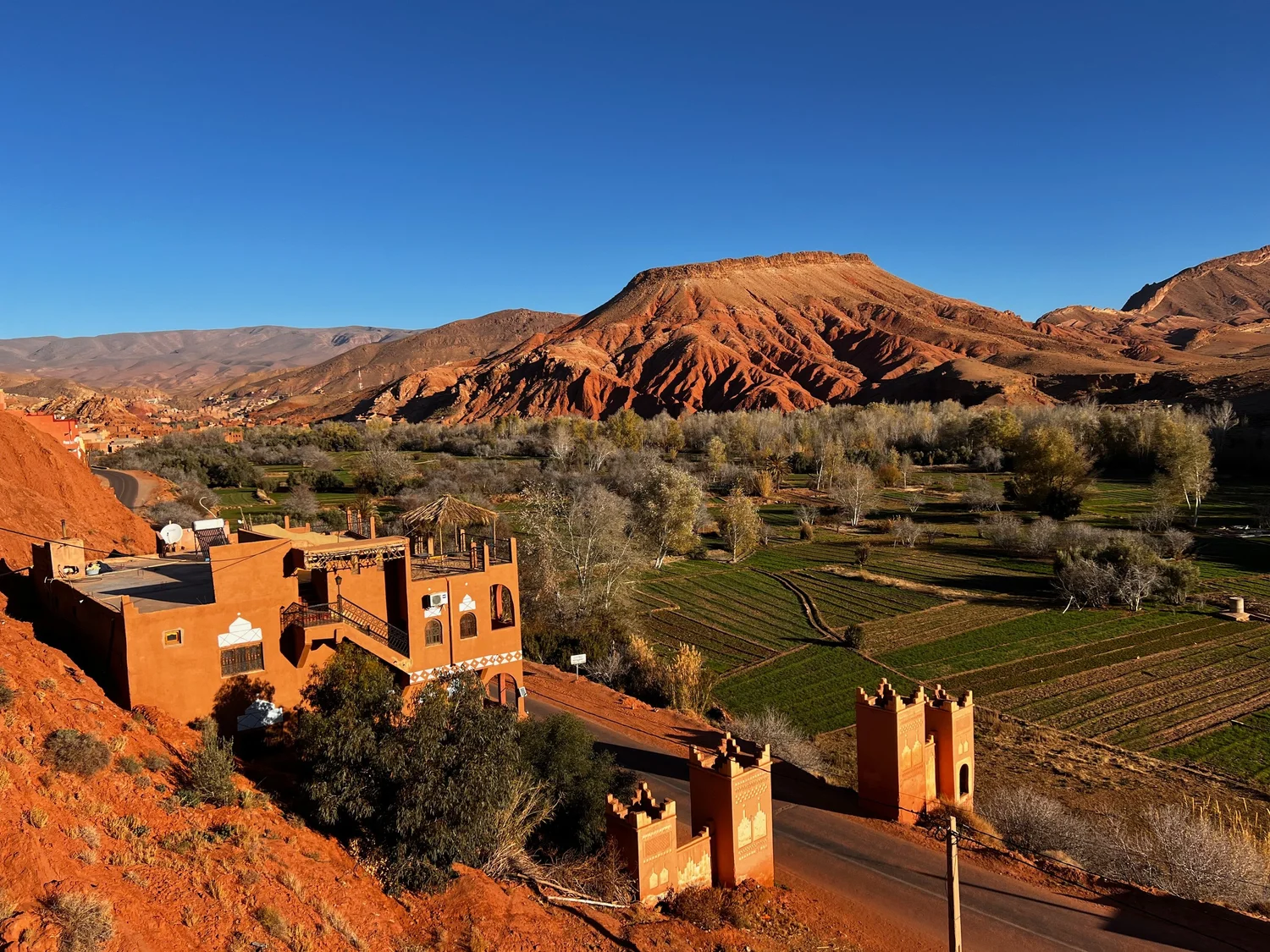
On the south side of the Atlas, on the road to the Sahara, the Todra Gorge has cliffs rising up to around 300 meters on both sides. Easy paths follow the river, and longer ones climb over the top for views down into the canyon. Walks in the nearby Dades Valley pass kasbahs and rock formations, and both fit easily into a desert trip.

When to go trekking in the Atlas
- Spring (April to June): the best season overall. The valleys are green, the orchards are in blossom and there is still snow on the high peaks into May.
- Summer (July and August): fine at altitude, but hot in the lower valleys. Start early and expect the odd afternoon thunderstorm.
- Autumn (September to October): settled weather and harvest time for apples and walnuts. Another very good season.
- Winter (December to March): Toubkal is a winter climb, and nights in the villages are freezing. Valley walks are still lovely on sunny days, and snow can close mountain roads for a while.
Mountain guides
Since late 2018, trekkers heading up Toubkal have had to go with a licensed local guide. Elsewhere it isn’t always required, but we strongly recommend one for any trek beyond a short valley walk. Paths aren’t always marked, the weather changes quickly at altitude, and several official travel advisories advise against hiking alone in remote areas.
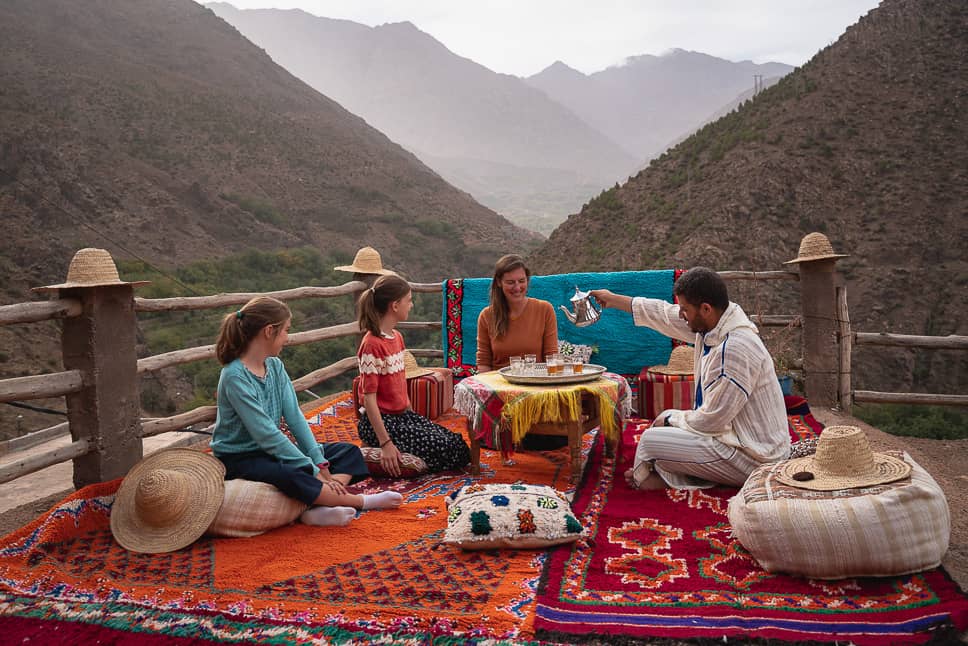
A good guide does far more than show the way. They arrange mules for the luggage, a cook and nights in village homes, and they turn a hike into a real visit: tea in someone’s kitchen, a walk through the terraced fields, the story of the village you’re passing through. Many of Morocco’s official mountain guides trained at the mountain training center in Tabant, in the Ait Bouguemez. We arrange licensed guides for every trek we plan, from a two-hour walk out of Imlil to Toubkal.
What to pack
- Broken-in hiking boots or sturdy trail shoes.
- Layers: a warm fleece and a windproof jacket, even in summer. Mountain nights are cold.
- Sun protection: hat, sunglasses and high-factor sunscreen.
- A refillable water bottle and purification tablets or a filter.
- A small first-aid kit, a headlamp, and some cash for village guesthouses.
- Modest clothing for walking through villages.
Hiking beyond the Atlas
The Rif Mountains and Chefchaouen
In the north, the Rif is greener, with cedar and fir forests, rivers and limestone gorges. From Chefchaouen, the Akchour trails lead to waterfalls and God’s Bridge, and multi-day routes cross Talassemtane National Park. Spring and autumn are best, and you will see far fewer hikers than in the Atlas.

Jebel Saghro and the Anti-Atlas
South of the High Atlas, Jebel Saghro is a rugged volcanic range of canyons and rock towers, best trekked in winter when the high mountains are snowy. Farther southwest, the Anti-Atlas around Tafraoute has pink granite boulders, palm-filled valleys such as the Ameln Valley, and almond trees that blossom in February.
Walking in the desert
Short walks in the Erg Chebbi dunes at Merzouga are easy to add to any desert trip. For a wilder trek, Erg Chigaga, reached from M’Hamid, is more remote, and multi-day walks there are supported by camels carrying the luggage. Desert walking is best from October to April.
Hiking responsibly
- Stay on the paths and keep off terraced fields, which are people’s livelihoods.
- Carry your rubbish out, and avoid plastic bottles where you can.
- Ask before photographing people, especially women and children.
- Stay in village guesthouses and buy locally, so your money stays in the valleys you walk through.
Atlas treks and tours
A day or two in the Atlas fits easily into a wider Morocco trip. These private tours already include time in the mountains:
- 11-Day Private Morocco Tour from Marrakech: a day trip to Imlil with a guided walk, then the Sahara, Fes and Chefchaouen.
- 12-Day Private Morocco Tour from Marrakech: a day in Imlil and the High Atlas before heading south to the desert.
- 5-Day Private Morocco Tour from Casablanca: Marrakech, the Atlas at Imlil and a night in the Agafay desert.
- 12-Day Private Morocco Tour from Tangier: the north, Fes and the Sahara, with a final day in Imlil.
Want a proper trekking trip, with nights in Imlil, Toubkal or the Ait Bouguemez? Tell us how much walking you enjoy and we will build a private route around it. You can also read about the best places to stay in the Atlas Mountains.
Frequently asked questions
Do I need a guide to trek in the Atlas Mountains?
For Toubkal, yes: a licensed local guide has been required since late 2018. For short valley walks near Imlil it is not compulsory, but for multi-day treks and remote areas we strongly recommend one.
How hard is it to climb Toubkal?
In summer and autumn it is a long, steep walk with no climbing, but the altitude makes it tiring. Good fitness and two days are enough for most people. In winter it is a mountaineering trip that needs crampons and an ice axe.
What is the best month for trekking in the Atlas?
May, June, September and October are the most reliable. April is beautiful but can still bring snow on the high passes.
Can I do an Atlas day trip from Marrakech?
Yes. Imlil and the Ourika Valley are both about an hour and a half away, so a day walk is easy. Toubkal needs at least two days.
Can I combine trekking with a desert tour?
Yes. The road to the Sahara crosses the High Atlas, so it is easy to add a day or two of walking before or after the desert.
Related reading
- Climbing Mount Toubkal: the full route
- 10 places to stay in the Atlas Mountains
- 6 beautiful lakes in Morocco
- Ait Ben Haddou: guide to the ksar over the Atlas
Plan your private Morocco trip
Our local team plans private tours around your dates, pace and interests, with support 24/7. Explore our Morocco tour ideas or ask us to plan your trip.


