Halal-friendly · private tours
Muslim-Friendly Morocco Tours
Private, tailor-made trips for Muslim families and friends: halal food everywhere, time for every prayer, and the great mosques and medersas of Fes, Rabat, Casablanca and Marrakech.
- 5.0 on Tripadvisor · 292 reviews
- Prayer stops built into every day
- Your own driver, no shared groups
- Private tours from €1,690 per person (7 days, 2 travelers)
Morocco is one of the easiest countries in the world for a Muslim family to travel in. The food is halal by default, the adhan sets the rhythm of every day, and wherever you are, from a Fes alleyway to a Sahara village, there is a mosque within walking distance. Our private tours add the parts a package tour can’t: a driver who stops when it’s time to pray, a guide who knows which mosques you can enter, and hotels chosen for families.
Every itinerary below can be changed. Tell us how you pray, what you eat and how fast you like to travel, and we’ll build the trip around it.
Why Morocco suits Muslim travelers
Around 99% of Moroccans are Muslim, and Islam is the state religion. In practice that means three things for visitors from Singapore, Malaysia, Indonesia or the Gulf.
Halal is the norm, not the exception. Meat in Moroccan butchers, restaurants and hotels comes from animals slaughtered the halal way, so you won’t be hunting for certificates the way you might in Europe. What you do need to watch is alcohol: big hotels have bars, and some restaurants serve wine. Pork is very rarely seen. If you’d like, we choose restaurants that don’t serve alcohol at all.
The call to prayer is part of daily life. You’ll hear the adhan five times a day from the minarets, and in the old medinas of Fes and Marrakech it rolls across the rooftops from dozens of mosques at once. Shops close briefly for Friday prayer, and the evening meal during Ramadan, ftour, is a family event.
Mosques are everywhere. Every town and most villages have one, and motorway rest areas usually have a small prayer room. Your driver can plan stops around Dhuhr and Asr on long road days, including the drive to the Sahara.
Planning around prayer, Friday and Ramadan
Daily prayers on the road
Prayer times shift through the year, so we plan each day around them: a morning visit that ends before Dhuhr, lunch near a mosque, and long drives broken up at Asr. Most Moroccans follow the Maliki school, so you’ll see many people pray with their arms at their sides. If you follow the Shafi’i school, as most Malaysians, Singaporeans and Indonesians do, you simply pray as you always have. In the desert camp at Merzouga, your guide can show you the qibla direction.
Friday prayers
Jumu’ah is the busiest prayer of the week, and many medina shops close around midday on Friday. If you want to pray Friday in a famous mosque, we can plan the week so that you’re in Fes for the Quaraouiyine, in Marrakech for the Koutoubia or in Casablanca for the Hassan II Mosque. Arrive early, as these mosques fill up fast. Friday lunch in Morocco is traditionally couscous, and we can arrange it with a family.
Traveling during Ramadan
Ramadan 2027 is expected to begin around 8 February, with Eid al-Fitr around 9 or 10 March, depending on the moon sighting. Morocco announces its own dates, which can differ by a day from Singapore or Kuala Lumpur.
During the day, cafés and restaurants that serve locals close, while hotel restaurants and many tourist restaurants in the big cities stay open. Shops open later, close for an hour or two around sunset, and reopen in the evening, when the medinas come alive. Most monuments stay open with shorter hours, and the Hassan II Mosque runs a reduced tour schedule. Expect some closures for a day or more around Eid.
For a fasting family, we keep days lighter, schedule drives in the morning, and book hotels that serve ftour and a late suhoor. Breaking the fast with harira, dates and chebakia is something you’ll remember.
Visiting and praying in Morocco’s mosques
This is the question we’re asked most. As a Muslim, you may pray in any mosque in Morocco, including the great historic ones. Your guide will take you to the door and explain to the caretaker if needed.
Non-Muslims are a different story. With very few exceptions, Moroccan mosques and shrines are closed to non-Muslim visitors. The famous exception is the Hassan II Mosque in Casablanca, which runs guided tours for visitors of every faith. If your group includes non-Muslim friends or relatives, they can still enjoy the medersas (Islamic colleges) of Fes and Marrakech, which are open to everyone, while you go in to pray.
Dress as you would at home: arms and legs covered, a headscarf for women, and shoes off at the door. Larger mosques have separate entrances or areas for women; small neighborhood mosques sometimes don’t, so ask your guide.
Islamic heritage, city by city
Fes
Fes was founded at the end of the 8th century and was for centuries the religious capital of Morocco. The Al Quaraouiyine mosque was founded in 859 by Fatima al-Fihri, a woman from Kairouan, and is often described as the oldest continuously operating university in the world. Muslims can join the prayers; non-Muslim visitors look into the courtyard from the doors.
Close by are two medersas that everyone can visit: the Al-Attarine Medersa beside the spice market, built in the 1320s, and the larger Bou Inania Medersa from the 1350s, with its carved cedar, zellige tilework and its own minaret. A few lanes away is the Zawiya of Moulay Idriss II, the tomb of the city’s founder and one of the holiest places in Morocco. It is open to Muslims only. Read more in our Fes travel guide.

Moulay Idriss Zerhoun
This white hill town about 28 km from Meknes is where Idris I, a descendant of the Prophet ﷺ, arrived in the late 8th century and founded Morocco’s first Islamic dynasty. His mausoleum is the heart of the town and is open to Muslims only. We usually pair it with the Roman ruins of Volubilis, a few kilometers away, on the drive between Rabat and Fes.
Rabat
Morocco’s capital holds the Hassan Tower, the unfinished minaret of a huge mosque begun by the Almohad sultan Yaqub al-Mansur in the 1190s and abandoned at his death. Across the esplanade is the Mausoleum of Mohammed V, where King Mohammed V and King Hassan II are buried. It is open to visitors, with royal guards at the gates. See our list of the best things to do in Rabat.
Casablanca
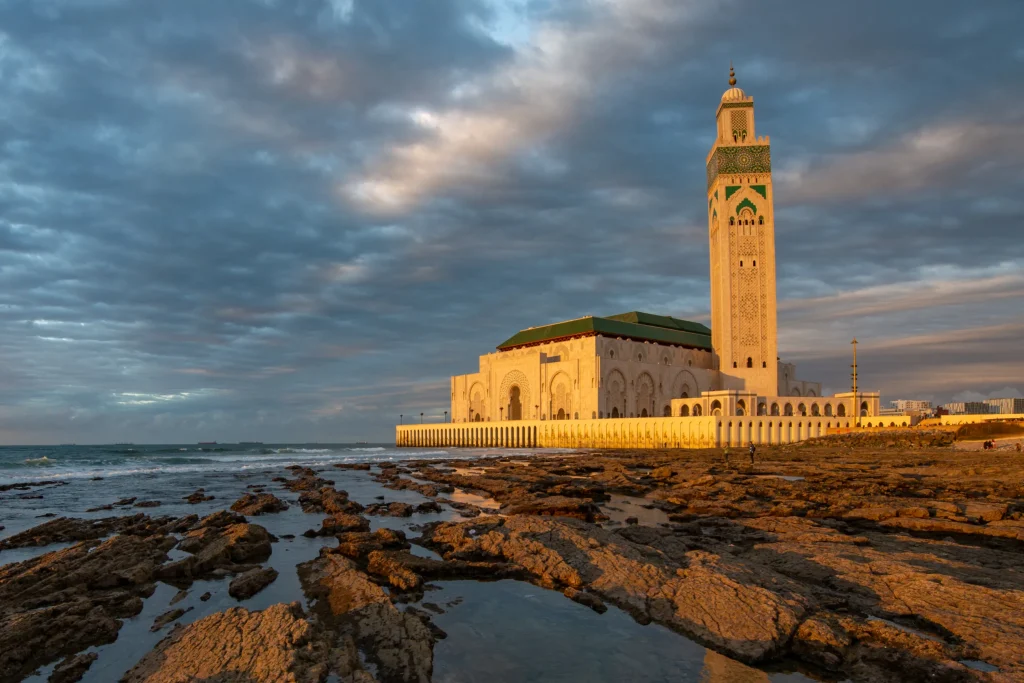
The Hassan II Mosque, opened in 1993, stands on the Atlantic with a minaret about 210 meters high, one of the tallest in the world. For Muslim travelers it’s a place to pray, and praying Maghrib here as the sun goes down over the Atlantic is hard to forget. Guided tours for visitors run several times a day except at prayer times, with fewer slots on Friday and in Ramadan. Our Casablanca guide has more.
Marrakech
The 12th-century Koutoubia minaret, about 77 meters tall, is the landmark you’ll steer by in Marrakech, and the mosque below it is open to Muslims for prayer. In the medina, the Ben Youssef Madrasa, built in 1564–65 under the Saadian dynasty and restored in recent years, is open to all and is one of the finest courtyards in North Africa. More ideas in our Marrakech guide.
Traveling as a family, or as women
Moroccans love children, and families with young kids are welcomed everywhere. Morocco has no legal dress code, but most Moroccan women dress modestly and many wear the hijab, so you’ll blend in easily. Loose clothes that cover shoulders and knees are comfortable and respectful for everyone, men included.
Here’s what we can arrange on request, subject to availability:
- A female guide for city visits, if that’s more comfortable for your family.
- Family rooms or connecting rooms, in riads inside the medinas or larger hotels with pools outside them.
- Alcohol-free stays, choosing riads and hotels that don’t serve alcohol, where we can.
- Prayer mats and the qibla direction in your room; just ask and we’ll request them from the hotel.
Sample routes: 7, 10 and 12 days
These are starting points. We change the order, slow it down for children and plan around Friday and your flights. Many travelers from Asia arrive in Casablanca via Doha, Dubai or Istanbul, so most of these routes start there.
7 days: the imperial cities and Moulay Idriss
- Day 1: Arrive in Casablanca. Hassan II Mosque, and Maghrib there if your flight allows.
- Day 2: Drive to Rabat (about 1 hour). Hassan Tower and the Mausoleum of Mohammed V.
- Day 3: Meknes, Volubilis and Moulay Idriss Zerhoun on the way to Fes.
- Days 4–5: The Fes medina: Al Quaraouiyine, the Bou Inania and Al-Attarine medersas, the Moulay Idriss II zawiya and the souks.
- Day 6: Back to Casablanca by road or train, or on to Marrakech.
- Day 7: Departure.
Want the Sahara as well? The 8-day private tour from Casablanca covers Rabat, Meknes, Fes, a night in the Merzouga desert and Marrakech in eight days.
10 days: Fes, the Sahara and Marrakech
Our 10-day private tour from Casablanca is the classic loop: Rabat, the blue town of Chefchaouen, Volubilis and Meknes, two nights in Fes, the Merzouga dunes, the Todra Gorge and Dades Valley, Ait Ben Haddou and Marrakech. We add Moulay Idriss on the Fes day and plan Friday prayer in Fes or Marrakech.
12 days: the full country at an easier pace
With 12 days there’s time to rest. The 12-day private tour from Marrakech suits travelers flying into Marrakech: the city and the High Atlas, the Sahara, Fes, two nights in Chefchaouen and Rabat, ending in Casablanca. If you land in Casablanca, the 12-day tour from Casablanca runs the same idea the other way round.
Muslim-friendly Morocco tours: your questions answered
Is all the food in Morocco halal?
Meat served in Morocco is halal as a matter of course, in restaurants, hotels and street food alike. The things to check are alcohol, which large hotels and some restaurants serve, and the occasional French-style dish cooked with wine in upscale restaurants. Tell us your preferences and we’ll pick restaurants that don’t serve alcohol.
Can Muslim visitors pray in any mosque in Morocco?
Yes. As a Muslim you’re welcome to pray in Moroccan mosques, including historic ones such as Al Quaraouiyine in Fes and the Koutoubia in Marrakech. Your guide can take you to the door and help if a caretaker has questions.
Can non-Muslims in our group enter mosques?
In general, no. Most mosques and shrines in Morocco are open to Muslims only. The main exception is the Hassan II Mosque in Casablanca, which runs guided tours for all visitors. Medersas such as Bou Inania in Fes and Ben Youssef in Marrakech are open to everyone.
Will the driver stop for prayers?
Yes. On a private tour the schedule is yours. Your driver will stop at a mosque or a motorway prayer room at Dhuhr and Asr, and we plan long drives so that you reach your hotel in good time for Maghrib.
Is it a good idea to visit Morocco during Ramadan?
It can be a beautiful time to come, as long as you expect a slower pace. Ramadan 2027 is expected to run from around 8 February to 9 or 10 March, depending on the moon sighting. Daytime cafés close, evenings are lively, and hotels serve ftour and suhoor. Expect some closures around Eid al-Fitr.
Can you arrange a female guide?
On request, yes, subject to availability in each city. Let us know when you enquire, especially if you travel in a busy season, so we can confirm it before you book.
Can you book alcohol-free hotels?
On request, we’ll look for riads and hotels that don’t serve alcohol on your route. Choice varies by town, and in a few places, such as the desert, the best option may be a hotel with a bar that you never need to visit. We’ll tell you exactly what each hotel offers in your proposal.
What should women wear in Morocco?
There’s no legal dress code, and many Moroccan women wear the hijab, so you’ll feel at home. Loose clothes covering shoulders and knees work everywhere. Bring a warm layer: desert nights and Atlas mountain roads get cold from November to March.
Is Morocco good for families with young children?
Very. Moroccans are warm with children, the food is familiar and gentle, and a private car means you can stop whenever the kids need a break. We suggest fewer long drives, a pool hotel in Marrakech and connecting rooms where possible.
Can we combine Morocco with umrah?
Many travelers do. Royal Air Maroc flies between Casablanca and Saudi Arabia, so you can add Morocco before or after umrah. Send us your umrah dates and we’ll plan the Morocco part around them.
Read before you go
Tell our local Moroccan team your dates, who is traveling and how you’d like us to plan around prayer, food and rest. We’ll send a private itinerary built around your family.
Photos





Private Morocco tours, planned by a local team. From your first ideas to your final transfer, we arrange your route, driver, guides and places to stay, with support 24/7.
Explore Our Tours
Plan Your Morocco Trip
Share your dates and the places you would like to see. Our local team will help you plan your private tour.
Follow our journeys
© 2017–2026 Morocco Top Trips. All rights reserved.


