Morocco Top Trips · Updated 5 November 2026
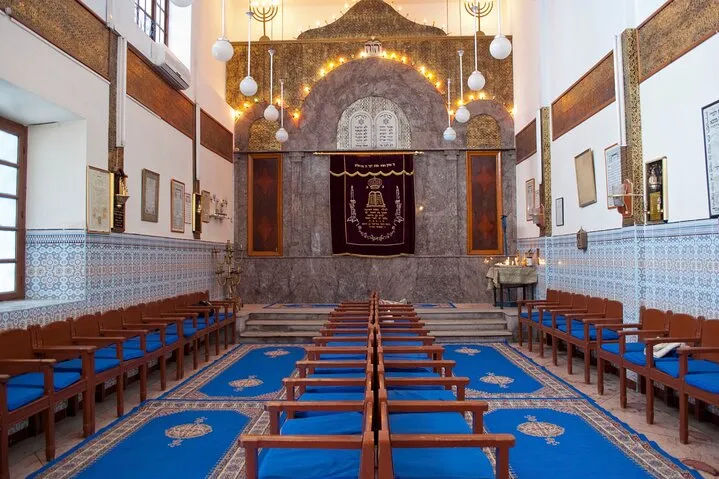
Morocco has more Jewish heritage open to visitors than anywhere else in the Arab world. There is a Jewish museum in Casablanca, restored synagogues in Fes, Marrakech and Essaouira, a mellah (the old walled Jewish quarter) in almost every historic city, and cemeteries where families still come to pray at the tombs of revered rabbis.
This guide goes city by city through the places worth your time, with notes on how each one is actually visited. For the story of Morocco’s Jews from ancient times to today, read our article on Jewish people in Morocco. If you would rather have the whole trip arranged for you, see our private Morocco Jewish tours.
In this guide
Before you go: how visits work
Very few of these places keep regular opening hours. Most synagogues and cemeteries are looked after by a caretaker, in several cities a Muslim family that has kept the keys for generations. You knock, wait a minute, and someone lets you in. A small donation toward upkeep is expected, either in the box or handed to the caretaker.
The Jewish calendar shapes everything. Synagogues and the Casablanca museum close to visitors on Shabbat, and sites can shut for holidays, funerals or services at short notice. Some city synagogues check ID at the door, so carry your passport. Dress as you would for a synagogue at home: shoulders and knees covered, and a head covering for men inside synagogues and in cemeteries.
Photography is usually fine in courtyards and cemeteries. Ask before you photograph inside a prayer hall, and never photograph people at prayer without their permission.
Casablanca
Morocco’s Jewish community is small today, a few thousand people, and most of them live in Casablanca. It is the one city where you find working synagogues, kosher restaurants and community life alongside the heritage sites, which makes it the natural place to start.
Museum of Moroccan Judaism
Opened in 1997 in the Oasis district, in a building put up in 1948 as a Jewish orphanage, the museum is often described as the only Jewish museum in the Arab world. Its rooms hold Torah scrolls, Hanukkah lamps, wedding costumes, Amazigh Jewish jewelry and a reconstructed workshop with the tools of the silversmith Saul Cohen. The bimah from Casablanca’s Beni-Issakhar synagogue stands here too.
At the time of writing it opens Monday to Thursday until mid-afternoon and on Friday mornings, and is closed at the weekend. Hours do change, so check before you go. The address is 81 Rue du Chasseur Jules Gros, about 20 minutes by car from the city center.
Temple Beth-El
Casablanca’s best-known synagogue was completed in 1949 on what is now Rue Jaber Ben Hayane, near the city center. People come for its stained-glass windows, often compared to the work of Marc Chagall. Beth-El is a working synagogue, so visits are arranged ahead and go through security. With a guide you can also walk the old medina, where many Jewish families lived before the modern city spread out around it.
Rabat
Rabat’s mellah lies in the eastern corner of the old medina, near the Bab el-Mellah gate and the Bou Regreg river. It is a busy working neighborhood, and the Jewish past shows mostly in the details: carved doorways, a few marked buildings and the Rabbi Shalom Zaoui synagogue. The old Jewish cemetery is close by. Rabat is about 1 hour 15 minutes from Casablanca and an easy stop on the way to Fes.
Meknes
Meknes was one of the great centers of rabbinic learning in Morocco. Its Jewish cemeteries hold the graves of revered rabbis such as Haim Messas, David Boussidan and Raphael Berdugo. The old cemetery beside the old mellah dates from 1682; it was restored and reopened in 2022 as part of a national program to restore Jewish heritage sites.
Meknes is unusual in two ways: its mellah is not next to the royal palace, and under the French Protectorate the community built a second, newer mellah. The city is an hour from Fes, so it fits on the drive from Rabat or into a half-day trip with the Roman ruins of Volubilis.
Fes
If you only have time for one Jewish quarter, make it Fes. The mellah, the synagogue and the cemetery sit within a few minutes’ walk of each other, and a morning with a good local guide brings them together.
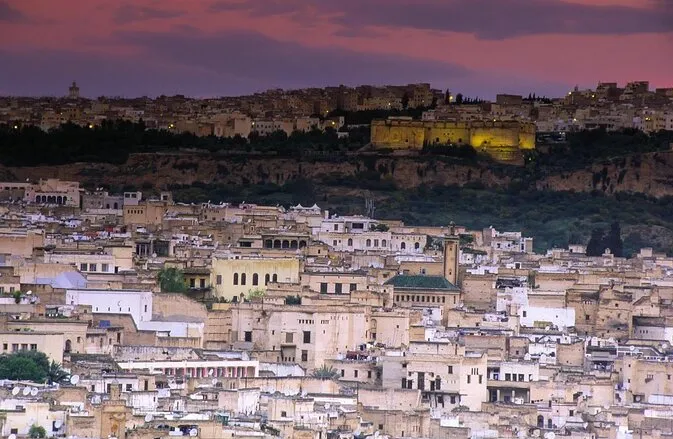
The mellah of Fes el-Jdid
The Fes mellah grew up beside the Royal Palace in Fes el-Jdid, probably in the 15th century, and it gave every other Jewish quarter in Morocco its name. Mellah comes from the Arabic word for salt. The houses look different from those of the old medina: instead of turning inward onto courtyards, many have wooden balconies and windows opening onto the street. Start at the Place des Alaouites, in front of the palace’s brass doors, and walk down the mellah’s main street.
Ibn Danan Synagogue
This 17th-century synagogue served the community for some three hundred years before falling into disrepair. It was placed on the World Monuments Watch in 1996 and reopened in 1999 after restoration. Inside you will see the prayer hall with its benches and bimah, and steps leading down to a ritual bath (mikveh) that was found during the work in 1997. A caretaker usually lets visitors in.
The Jewish cemetery and Slat al-Fassiyine
At the southeastern edge of the mellah, the Jewish cemetery is a hillside of whitewashed tombs. The most visited is the green-roofed tomb of Lalla Solica Hatchuel, a girl of 17 who was executed in 1834 for refusing to convert to Islam and is honored as a martyr. Close by, the restored Slat al-Fassiyine synagogue is worth asking your guide about. Entry to the cemetery is free, though a donation for its upkeep is welcome.
Sefrou
Thirty kilometers south of Fes, about 40 minutes by car, Sefrou was nicknamed the little Jerusalem of Morocco. In the late 19th century nearly half the town was Jewish, and the mellah still takes up about half of the old town, with three-story houses and balconies hanging over the lanes. The Jewish cemetery has been restored with money from families abroad; some of its memorials honor the victims of a 1950 flood.
Just outside town, the caves of Kef el-Moumen hold a tomb that tradition links to the prophet Daniel, a place visited by Jews and Muslims alike. Allow half a day from Fes.
Marrakech
The Mellah
The Marrakech Mellah was laid out in the 16th century under the Saadian sultans, beside the royal kasbah and close to what is now the Bahia Palace. Several of its streets have been given back their original names. Look for the covered spice market and the jewelers’ workshops, two trades long tied to the Jewish families who lived here.
Slat al-Azama (Lazama) Synagogue
Tradition says the Slat al-Azama synagogue was founded in 1492 by Jews expelled from Spain. The present building is about a century old, arranged around a tiled courtyard, and it is still used for prayer. It is closed to visitors on Saturdays; on other days the caretaker shows visitors in, and a donation is expected.
Miâara Jewish cemetery
A short walk away on the edge of the Mellah, Miâara is the largest Jewish cemetery in Morocco, with more than 20,000 graves. The domed tombs of revered rabbis stand around its edges, and one section holds thousands of small graves of children who died in a 19th-century typhus epidemic. A guard lives on site, and you will be asked for a donation at the gate. Men should cover their heads.
Essaouira
Under its old name, Mogador, Essaouira was Morocco’s main port for much of the 19th century, and Jewish merchants handled a large share of its trade with Europe. The mellah lies in the north of the medina, near Bab Doukkala and the sea walls. Many of its houses are in poor repair, but its synagogues and its museum have been carefully restored.
Bayt Dakira
Bayt Dakira, “house of memory,” opened in 2020 in a restored house in the mellah. It holds photographs, documents and objects from Jewish family life in Essaouira, and it includes the Simon Attias Synagogue and a research center named after the scholar Haim Zafrani. It is the best single place to understand how Jews and Muslims lived side by side in this town.
Rabbi Haim Pinto synagogue and tomb
Rabbi Haim Pinto (1749–1845) led Essaouira’s rabbinic court for more than 70 years. His synagogue, in the house where he lived in the mellah, is still kept up and can be visited with a guide. His tomb is in the Jewish cemetery just outside the walls, where pilgrims gather every September for his hiloula. While you are in the mellah, ask about Slat Lkahal, the old community synagogue.
Tangier
Tangier’s Jewish community had close ties to Spain and Gibraltar, and later to the city’s years as an international zone. In 2022 the Assayag synagogue, founded in 1890, reopened as the Beit Yehuda museum of Jewish history and culture. The Nahon synagogue stands in the medina nearby. Tangier makes sense if you cross by ferry from Spain or start your tour in the north.
Tinghir and the southern valleys
For centuries Jewish families lived in the oasis towns of the south beside their Amazigh neighbors, working as silversmiths, traders and craftsmen. Most left in the 1950s. In Tinghir, at the mouth of the Todra Gorge, the mellah sits at the heart of the old kasbah, and its story is told in Kamal Hachkar’s documentary Tinghir-Jerusalem (2013). Other mellahs survive in the Draa and Dades valleys, many of them in ruins, so ask your driver which are safe to enter.
Pilgrimages and hiloulas
Moroccan Jews have long visited the tombs of saintly rabbis on the anniversary of their death. These gatherings are called hiloulas. The largest is at the tomb of Rabbi Amram Ben Diwan near Ouezzane, in the foothills of the Rif, around Lag BaOmer. Essaouira’s hiloula for Rabbi Haim Pinto falls in September. Families fly in from Israel, France and North America to light candles, pray and share long meals. Visitors can sometimes attend, but these are community events with tight security, so ask well ahead.
Fitting the sites into one trip
Most people combine three or four of these cities. A week covers Casablanca, Rabat, Meknes, Fes and Sefrou. Ten days lets you add Marrakech and Essaouira. Around two weeks takes in the north, the Sahara and the southern valleys. Our Morocco Jewish tours page sets out sample 7-, 10- and 13-day routes, including the 13-day Jewish heritage itinerary day by day.
Plan Shabbat first. It decides where you sleep on Friday and Saturday and which sites you can see on which days. If you keep kosher, read our guide to kosher food in Morocco before you plan meals.
Related reading
- Jewish people in Morocco: history and culture
- Kosher food in Morocco: where to eat and what to try
- Is Morocco safe for Jewish travelers?
- Best things to do in Fes
- Best things to do in Essaouira
- Best things to do in Casablanca
Plan your private Morocco trip
Our local team plans private tours around your dates, pace and interests, with support 24/7. Explore our Morocco tour ideas or ask us to plan your trip.