Morocco Top Trips · Updated 5 November 2026
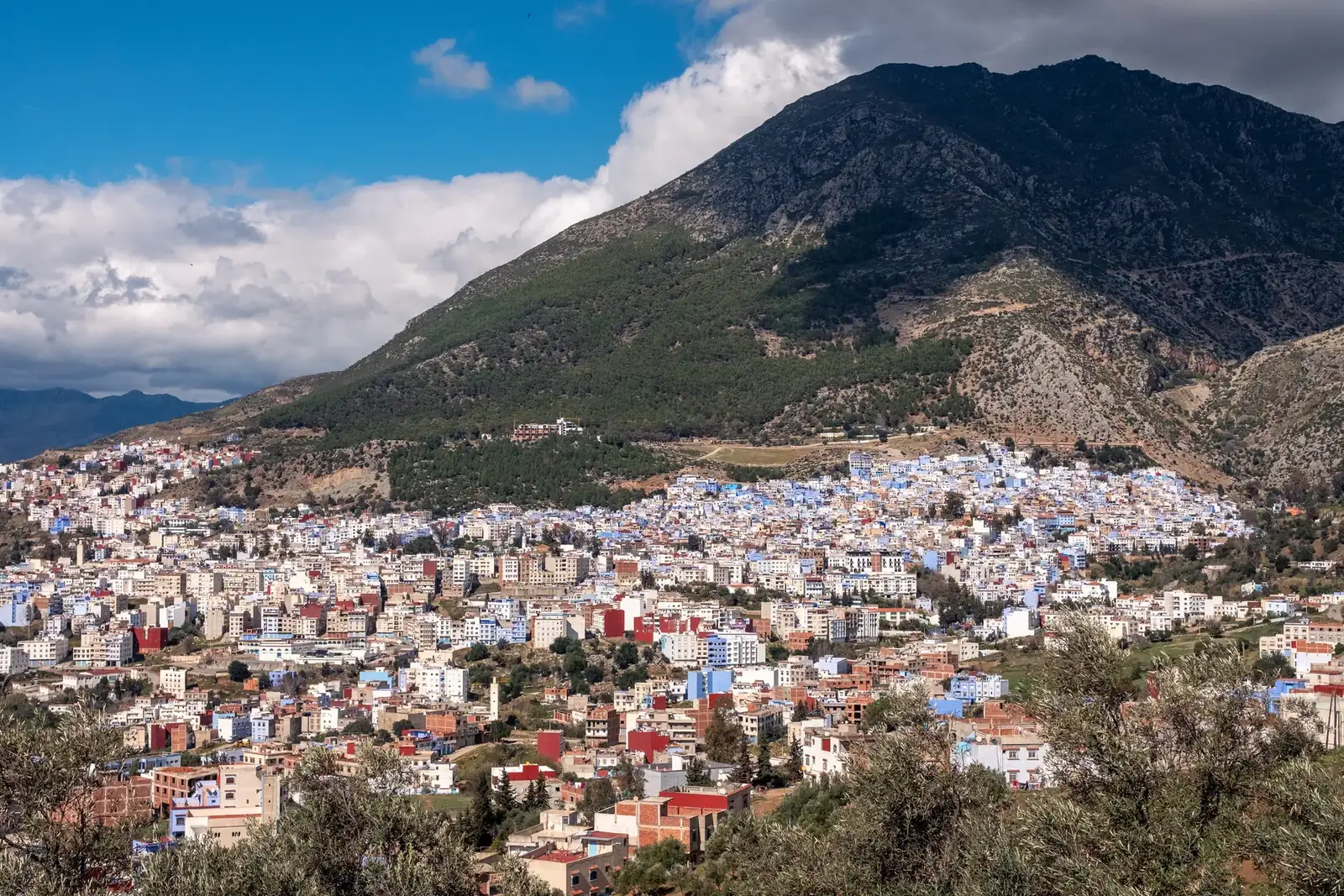
Chefchaouen sits high in the Rif Mountains of northern Morocco, its old town washed in every shade of blue you can imagine. Photos make it look almost unreal, and the good news is that it really does look like that. The town is small, slow-paced and friendly, a welcome change after Fes or Marrakech.
This guide covers why the town is blue, how to get there from Fes and Tangier, whether to visit on a day trip or stay the night, the best photo spots and the Akchour waterfalls. Our advice in one line: stay at least one night, because Chefchaouen is at its best early in the morning and in the evening, after the day visitors have gone.

A short history of Chefchaouen
Chefchaouen was founded in 1471 by Moulay Ali ben Rachid as a fortress against Portuguese raids along the coast. Its name comes from the Amazigh word for “horns”, after the two peaks that rise above the town. In the decades that followed, Muslim and Jewish families expelled from Andalusia settled here and gave the medina its Spanish look: whitewashed walls, tiled roofs and wooden balconies.
For centuries the town was hard to reach, and few outsiders came. Spain took it in 1920, and it returned to Morocco at independence in 1956. You’ll still hear plenty of Spanish in the shops and cafés.
Why is Chefchaouen blue?
The honest answer is that nobody knows for sure. Ask five people in the medina and you’ll hear five stories. These are the ones you’ll come across most:
- The Jewish tradition. In Jewish belief, blue stands for the sky and heaven. Many people credit the town’s Jewish families with the first blue walls, and some link the stronger blues to Jewish refugees who arrived in the 1930s. Older residents often say the blue was once mostly in the mellah, the Jewish quarter.
- Keeping mosquitoes away. Some say blue looks like running water and that mosquitoes avoid it. It is a popular story, though there is no real evidence for it.
- Staying cool. Blue lime wash may keep houses a little cooler in summer. That probably isn’t why it started, but it may be one reason it lasted.
- Water and the sky. Locals sometimes connect the color with the Ras el Maa spring, the town’s water source, or simply with the sky above the mountains.
- Visitors. The blue is now the town’s calling card. People keep repainting because travelers love it, and that is the most certain reason of all.
One thing to know: as you drive in, the newer part of town isn’t blue at all. Don’t be disappointed. The blue starts as soon as you walk through the gates of the old medina.
Things to do in Chefchaouen
Wander the blue medina

The main activity in Chefchaouen is simply walking. Staircases, doorways and alleys open onto little squares full of flower pots and painted walls. The medina is small enough that you can’t stay lost for long; if in doubt, walk downhill and you’ll reach the main square.
Outa el Hammam square and the Kasbah
The main square is lined with cafés and overlooks the red-walled Kasbah, built in the 15th century. Inside there is a small museum, a garden and a tower with views over the rooftops. Next to it stands the Grand Mosque, with its unusual octagonal minaret. In the evening, this is the place to sit with a mint tea and watch town life.
Shopping and food

Chefchaouen is a good place to buy woven blankets, wool jellabas, leather and woodwork, usually with less pressure than in the big cities. For food, try the local goat cheese, bissara (fava bean soup) for breakfast and a simple tagine on one of the rooftop terraces.

Best time and photo spots
Spring (March to May) and autumn (September to November) are the nicest months, with mild days and green hills. Summer is warm and busy with Moroccan and Spanish visitors. Winter is cool and often rainy, but the town is quiet and the mountains look beautiful. Bring a warm layer at any time of year, because evenings in the Rif get chilly.
For photos, the time of day matters more than the month. Between about 7 and 9am the lanes are empty, the light is soft and you’ll see residents sweeping their steps and carrying bread to the oven. By late morning the day-trippers arrive and the famous corners get crowded.
Ras el Maa
At the eastern edge of the medina, mountain water rushes out of the rock at Ras el Maa. Local women still wash clothes in the stone basins, and there are small cafés by the stream. It is a cool, shady spot on a hot afternoon and a good place for photos of everyday life. Please ask before you photograph people, and accept a polite no.
The Spanish Mosque viewpoint
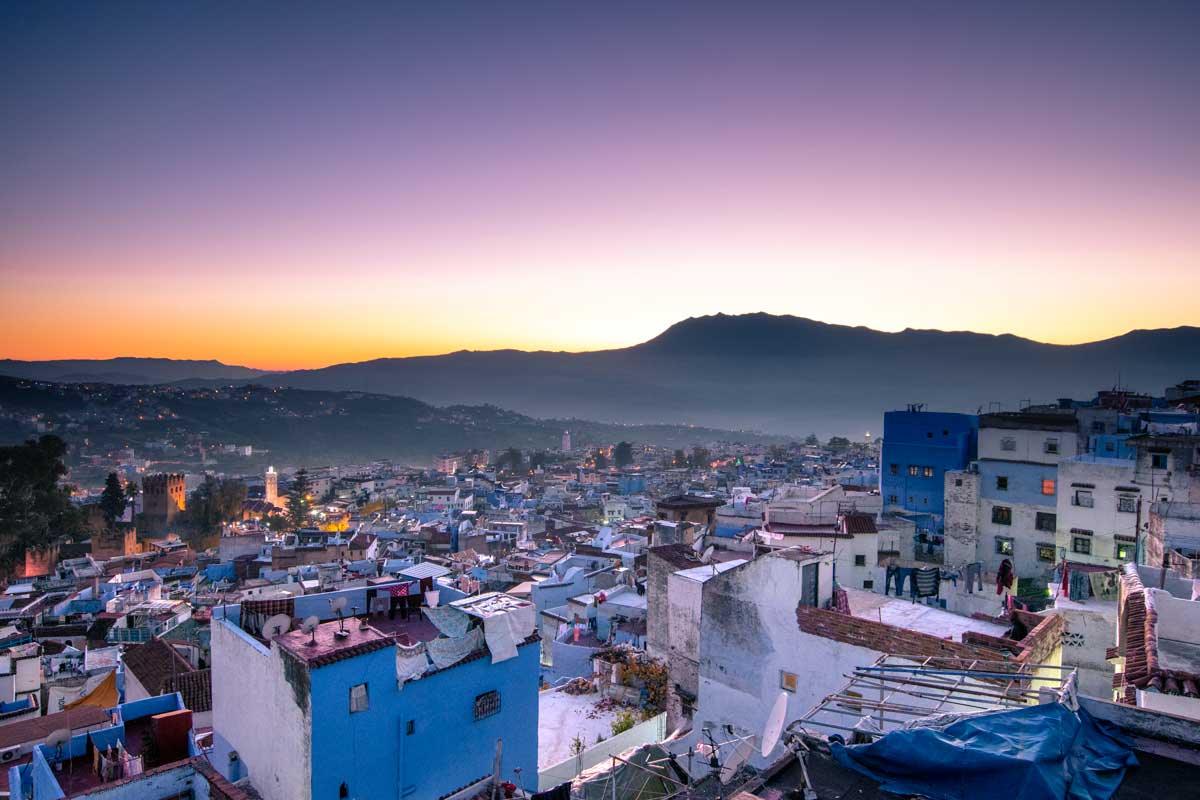
From Ras el Maa, a path climbs about 30 minutes up the hillside to the Spanish Mosque, a small white mosque built in the 1920s. This is where you get the classic view of the whole blue town spread across the valley. Come about an hour before sunset, bring water and a light jacket, and use your phone torch for the walk down.
Blue lanes and doorways
The most photographed lanes are in the upper medina, between Outa el Hammam and Ras el Maa. Some residents decorate their steps for visitors and may ask for a small tip if you set up a photo shoot outside their door. That is fair; a few dirhams is normal.
Akchour waterfalls and God’s Bridge
Akchour is about 45 minutes by road from Chefchaouen, at the edge of Talassemtane National Park. From the small dam where the road ends, two trails split. The river trail reaches the first waterfall in about an hour and the big waterfall in about two hours, crossing the stream a few times on stones and small bridges. The other trail takes about 45 minutes to reach God’s Bridge, a natural rock arch high above the gorge.
Allow at least half a day and wear shoes you don’t mind getting wet. Summer is the time to swim in the pools; after the autumn rains the falls are at their strongest. The paths can be slippery in winter. With a second night in Chefchaouen, Akchour makes an easy and very rewarding morning out.
Getting to Chefchaouen
Fes to Chefchaouen
Fes to Chefchaouen is roughly 200 km. The drive takes about three and a half hours, closer to four with a coffee stop. The usual road heads north-west through farmland and olive groves to Ouazzane, then climbs into the Rif. It is a scenic drive, with long views over the hills in spring, and the last stretch is a winding mountain road.
From Tangier, Rabat and Casablanca
- From Tangier: about 2.5 hours, usually via Tetouan.
- From Rabat: about 4 hours.
- From Casablanca: about 5 hours, so most travelers break the journey in Rabat.
There is no train to Chefchaouen. Buses run from Fes and Tangier, but a private driver lets you stop at viewpoints and arrive rested.
Day trip or overnight stay?
A day trip works if you’re short on time. From Tangier it is comfortable: about five hours on the road in total, with four or five hours in town. From Fes it is a long day, with seven to eight hours of driving for the round trip, and you’ll see the medina at its busiest.
An overnight stay is what we recommend for most travelers. You get the empty lanes at sunrise, sunset at the Spanish Mosque and a quiet dinner on a terrace. With two nights, you can add the Akchour waterfalls without rushing. Chefchaouen also sits naturally between Tangier and Fes, so on a longer tour the night there adds almost no extra driving.
Where to stay
Stay inside the medina, so you can step out into the blue lanes early in the morning. A few places our travelers enjoy, from classic riads to our premium pick:
- Lina Ryad & Spa: a boutique hotel in the medina with a small spa and a pool.
- Riad Dar Cherifa: a restored traditional house with a lovely courtyard.
- Dar Jasmine: a cozy guesthouse with mountain views.
- Taj Chefchaouen: the hotel we book on our premium and VIP tours, for travelers who want more space and comfort after a day in the medina.
Private tours that include Chefchaouen
Every tour below is private, with your own driver, and can be adjusted to add a second night in the Blue City.
- Day trips: the private Chefchaouen day trip from Tangier or the private Chefchaouen day trip from Fes.
- From Tangier: the 8-day tour from Tangier, the 10-day tour from Tangier or the 12-day tour from Tangier. See all tours from Tangier.
- From Casablanca: the 10-day tour from Casablanca, the 11-day Moroccan highlights tour or the 14-day tour from Casablanca. See all tours from Casablanca.
- From Marrakech: the 10-day tour from Marrakech or the 12-day tour from Marrakech, which reach the north after the Sahara and Fes.
Starting in Fes? Our tours from Fes page shows the shorter routes, and our guide to day trips from Fes compares Chefchaouen with Meknes and Volubilis.
Frequently asked questions
Why is Chefchaouen painted blue?
Nobody knows for certain. The most common explanation links the blue to the town’s Jewish families, for whom blue symbolized the sky and heaven. Other stories mention keeping mosquitoes away or keeping houses cool. Today residents repaint mainly because visitors love it.
How far is Chefchaouen from Fes?
About 200 km. The drive takes around three and a half hours, or closer to four with a stop, on a road that goes through Ouazzane and into the Rif Mountains.
Can I visit Chefchaouen as a day trip?
Yes. It is an easy day trip from Tangier (about 2.5 hours each way) and a long one from Fes (about 3.5 to 4 hours each way). We recommend staying overnight if you can, to see the medina early in the morning and at sunset.
How long should I stay in Chefchaouen?
One night is the minimum to enjoy it without the crowds. Two nights let you add a morning hike to the Akchour waterfalls or God’s Bridge.
What is the best time to visit Chefchaouen?
March to May and September to November bring mild weather and green hills. Whatever the season, go out between 7 and 9am for empty lanes and soft light.
How do I get to the Akchour waterfalls?
Akchour is about 45 minutes by road from Chefchaouen. From the dam, the walk to the first waterfall takes about an hour and to the big waterfall about two hours. God’s Bridge is about 45 minutes on a separate trail.
Is Chefchaouen safe?
Chefchaouen is a calm, friendly small town. Use the same common sense you would anywhere, and politely decline offers you aren’t interested in.
Plan your visit
Want to include Chefchaouen in your trip? Tell us your dates, and we’ll plan a route with the right amount of time in the Blue City. You might also like our guide to the best places to visit in Morocco.