Morocco Top Trips · Updated 5 November 2026
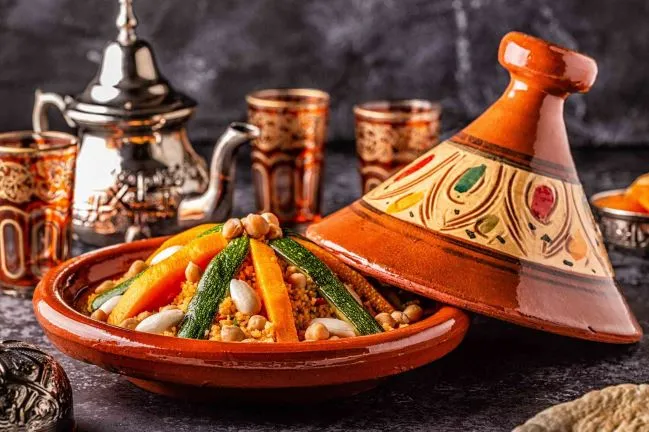
Morocco is one of the easier countries in the Muslim world in which to travel kosher, but it takes planning. Casablanca has restaurants, butchers and bakeries that serve a working Jewish community. Marrakech has a handful of kosher places. Outside those two cities, a kosher meal is something you arrange ahead, not something you find on the street.
This guide covers how kosher supervision works here, where to eat, the Moroccan Jewish dishes worth asking for, and how we plan meals on a private tour. For the synagogues, mellahs and cemeteries themselves, see our guide to Jewish heritage sites in Morocco.
In this guide
- How kosher supervision works in Morocco
- Where to find kosher food, city by city
- Shabbat meals on the road
- Moroccan Jewish dishes worth knowing
- Mimouna: the night Passover ends
- High Holidays and Passover
- Practical tips for eating kosher
- Frequently asked questions
- Kosher meals on a private tour
- Related reading
How kosher supervision works in Morocco
Kashrut in Morocco is overseen by the rabbinate of the Jewish community, based in Casablanca, and by Chabad, which has worked in the country for decades. A few restaurants also carry supervision from agencies abroad. When you walk into a place, ask to see the certificate and who signs it. If you keep a particular standard, such as glatt or chalav Yisrael, say so, because not every place offers both.
Halal is not kosher. Travelers ask this a lot, so it is worth being clear: halal meat is slaughtered and supervised under different rules, and an ordinary Moroccan kitchen mixes meat and dairy equipment freely. However willing the staff, a regular restaurant or riad cannot serve you a kosher meal.
Where to find kosher food, city by city
Kosher restaurants in Morocco open, close and change supervision more often than guidebooks keep up with. Treat every name below as a starting point, true at the time of writing, and confirm before you travel.
Casablanca
Casablanca has by far the most choice. The community clubs, such as the Cercle de l’Alliance and the Cercle de l’Union, have long served kosher meals, and there are kosher bakeries, butchers and grocery shelves in the neighborhoods where the community lives. Chabad in Casablanca offers Shabbat meals to visitors who register in advance. If you are flying in, this is the place to stock up on snacks for the road.
Marrakech
Marrakech has a few kosher restaurants, mostly in the new town of Guéliz rather than in the medina. At the time of writing, Dar Ima on Rue de la Liberté in Guéliz is listed as glatt kosher under the supervision of the Casablanca community, serving Moroccan dishes and grills, with reduced hours on Friday. Some hotels can also bring in meals from an outside kosher kitchen for a private dinner. For Shabbat, book well ahead, especially around the holidays.
Fes, Meknes and Rabat
The choice here is much smaller. In Fes, the community center has served kosher meals, mainly around Shabbat, so ask ahead rather than counting on walk-in dining. Rabat has had a kosher community club. In Meknes, plan on meals brought in from elsewhere.
Essaouira, the mountains and the desert
Expect supervised meals prepared elsewhere and delivered sealed, or packed for the day. A desert camp can serve sealed kosher meals if they are arranged before you travel, but it cannot cook kosher itself. On road days, fresh fruit, dates, nuts and bread from a kosher bakery go a long way.
Shabbat meals on the road
Shabbat is where planning matters most. You need Friday dinner, Saturday lunch and the third meal, all ready before sunset on Friday and within walking distance of where you sleep. In Casablanca and Marrakech, that usually means a community or Chabad meal, or a kosher restaurant that takes Friday bookings and Saturday meals paid in advance.
Elsewhere, we arrange sealed meals delivered on Friday afternoon and ask the hotel to keep them cold, and to allow a hot plate if you use one. If you want to attend services, choose a hotel within walking distance of a synagogue, which in practice means Casablanca or Marrakech. Ask for a metal room key if you avoid electronic ones; many riads still use them.
Moroccan Jewish dishes worth knowing
Moroccan Jewish cooking shares a lot with the Muslim kitchen next door: saffron, cumin, preserved lemon, olives and long, slow cooking. It also has dishes of its own, many of them built around Shabbat and the holidays. For the wider Moroccan table, see our guide to Moroccan food.
Dafina (skhina)
This is the Shabbat stew. A heavy pot of beef, chickpeas, potatoes, sweet potatoes, wheat or rice tied in a cloth, and whole eggs in their shells goes into a low oven on Friday afternoon and comes out for lunch on Saturday. Overnight the eggs turn brown and creamy. Some families and regions call it skhina, from the Arabic word for hot. Every family has its own recipe, and every family is sure theirs is the right one.
Salads and Friday-night fish
Shabbat and holiday meals often open with six to eight small salads, known as kemia: carrots with cumin, roasted peppers, eggplant, beets and olives. Friday dinner frequently includes fish cooked with red peppers, garlic, coriander and paprika, a dish that turns up in some form in almost every Moroccan Jewish home.
Pastilla, couscous and holiday dishes
Chicken pastilla, sweet and savory under its dusting of sugar and cinnamon, is a celebration dish in Jewish homes as well as Muslim ones. Couscous is common in the south, and holiday versions come with almonds, raisins and cinnamon. At Rosh Hashanah many families serve sweet dishes for a sweet year.
Mahia
Mahia is a clear spirit distilled from figs or dates, traditionally made by Moroccan Jewish families and drunk in small glasses at celebrations. It is strong, so sip it.
Mimouna: the night Passover ends
On the night Passover ends, Moroccan Jewish families open their doors for Mimouna. Tables are laid with flour, wheat stalks, mint and flowers, and the first leavened food after the holiday is mofleta, a thin pancake spread with butter and honey, rolled up and eaten with mint tea. Zaban, a soft almond nougat, and sweets of every kind fill the table. Dark, sour and salty foods are avoided, and dairy takes the place of meat.
In the old mellahs, Muslim neighbors often brought the first flour, milk and butter after the holiday, and the visiting back and forth between neighbors is part of what Mimouna celebrates. Today it is kept wherever Moroccan Jews live, from Israel to Montreal.
High Holidays and Passover
Around Rosh Hashanah, Yom Kippur, Sukkot and Passover, demand for kosher food in Morocco rises sharply, above all in Casablanca and Marrakech, where many visitors of Moroccan origin come for the holidays. Restaurants may close to the public for community meals or serve set holiday menus only. If your dates fall near a holiday, plan meals at the same time as you book flights.
For Passover, most observant visitors join an organized program at a hotel whose kitchen is kashered and supervised for the whole holiday. These programs book up months ahead, and the price and standard vary a lot, so ask exactly who supervises before you pay.
Practical tips for eating kosher in Morocco
- Tell your tour operator the exact standard you keep, in writing, before anything is booked.
- Book Shabbat meals by Thursday at the latest, and weeks ahead around the holidays.
- Carry snacks for long road days, such as dried fruit, nuts and packaged food from home or from a kosher grocery in Casablanca.
- Ask for a room with a fridge if you will be carrying sealed meals.
- Buy fresh fruit and vegetables at the markets; your guide will know the best stalls.
Frequently asked questions
Can our riad cook kosher food for us?
No. A riad kitchen is not kosher, however good the cook. What a good riad can do is serve sealed meals brought in from a supervised kitchen, keep them cold, provide disposable plates and cutlery, and give you a quiet table at the time you choose.
Is there kosher food in the Marrakech medina?
Very little. The kosher restaurants are mostly in Guéliz, the new town, about 10 to 15 minutes by car from the medina. On sightseeing days, plan a packed lunch or have your driver take you to Guéliz.
Do we need to bring food from home?
For Casablanca and Marrakech, not much. For the rest of the trip, bring the snacks you rely on, any packaged products with a hechsher you trust, and enough for one extra day in case a delivery runs late.
Kosher meals on a private tour
On our private tours we plan meals before we plan hotels. We confirm a supervised source for each night outside Casablanca and Marrakech, arrange sealed meals for the desert and the long drives, and choose hotels that will serve them properly and give you a fridge. Some travelers keep strictly kosher for every meal; others eat in kosher restaurants in the cities and keep to a simpler standard in between. Tell us where you draw the line, and we will write down what each meal will be so there are no surprises.
See the sample 7-, 10- and 13-day routes on our Morocco Jewish tours page, including the 13-day Jewish heritage itinerary, or tell us your dates and requirements and we will plan around them.
Related reading
- Jewish heritage sites in Morocco: a city-by-city guide
- Jewish people in Morocco: history and culture
- Moroccan food: a food lover’s guide
- Is Morocco safe for Jewish travelers?
- Best things to do in Casablanca
Plan your private Morocco trip
Our local team plans private tours around your dates, pace and interests, with support 24/7. Explore our Morocco tour ideas or ask us to plan your trip.