

Morocco Top Trips · Updated 6 November 2026
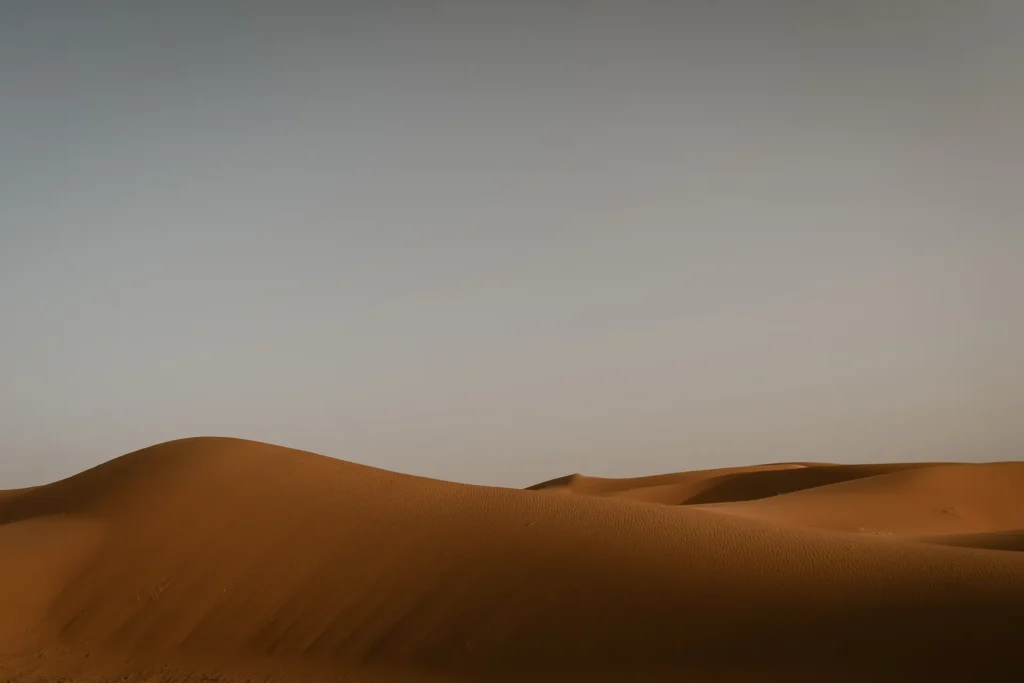
Merzouga is a small village on the western edge of the Erg Chebbi dunes, in the far southeast of Morocco. For most visitors it is where the Sahara finally looks the way they pictured it: tall orange dunes, camel caravans and a night sky crowded with stars. For our founder, Mohamed, it is simply home. He grew up here, and much of this guide is the advice he gives friends before they come.
This guide covers the practical side: how to get to Merzouga from Marrakech or Fes, the dunes, how the desert camps work, when to come, Khamlia and its Gnawa music, the Lake Yasmina area and what to pack. For a list of activities, see our guide to things to do in Merzouga.
In this guide
Merzouga at a glance
Merzouga sits in the Tafilalt region, about 35 km southeast of Rissani and roughly 55 km from Erfoud. The Algerian border is not far to the east. The village is a few streets of earth-colored houses, small shops and guesthouses facing the sand. A little to the north, Hassi Labied is the second village on the dunes, and many hotels and camel rides start from there. A few kilometers south is Khamlia.
When people say “Merzouga,” they usually mean the whole area: the villages, the dunes and the camps inside them.
Getting to Merzouga from Marrakech
Merzouga is about 560 km from Marrakech by road. Driving straight through takes nine to ten hours with short stops, and the road climbs over the High Atlas at the Tizi n’Tichka pass (2,260 m), so parts of it are slow. We never drive it in one go on the way in. The usual plan is two days:
- Day 1: Marrakech to Ait Ben Haddou and Ouarzazate, then on to the Dades Valley or Todra Gorge for the night.
- Day 2: Todra Gorge in the morning, then through Tinejdad and Erfoud to Merzouga, arriving in the afternoon in time for the camel ride.

That is why our shortest Sahara trip from Marrakech is three days, and why we prefer four. Our Marrakech to Merzouga planning guide goes through the route stop by stop.
Getting to Merzouga from Fes
From Fes it is about 460 km, or seven to eight hours with stops. It is a long day, but one you can do in one go, and the landscape keeps changing: cedar forests and Barbary macaques around Ifrane and Azrou, the high plains near Midelt, then the Ziz Gorges and a long ribbon of palm groves down the Ziz Valley to Erfoud.
Leave Fes around 8 a.m. and you reach the dunes in time for sunset. Our 3-day Merzouga desert tour from Fes and the 3-day tour from Fes to Marrakech both take this road.
Other ways to get there
The nearest airport is Errachidia (Moulay Ali Cherif), about 126 km and two hours from Merzouga, with mostly domestic flights. Ouarzazate airport is about five hours away. Supratours and CTM buses reach the area from Marrakech and Fes, but the trip takes most of a day or a night and leaves you in the village, so you still need a transfer to your camp. Check current schedules before planning around them.
Erg Chebbi, the dunes
Erg Chebbi is a sea of sand about 28 km long from north to south and 5 to 7 km wide. The highest dunes rise up to about 150 meters above the flat, stony desert around them. That is what makes the first sight so striking: you drive across black gravel plain, and then the orange wall of sand appears.

The color changes through the day. Early morning is pale pink and gold, midday is flat and bright, and the last hour before sunset turns the sand deep orange. The wind keeps reshaping the ridges, so the dunes never look quite the same twice.
The classic things to do are a camel ride, sunrise from a high dune, sandboarding and a 4×4 loop around the erg. Our guide to things to do in Merzouga covers each one, and camel trekking in the Sahara explains how the rides work.
The desert camps
Most visitors spend at least one night in a camp inside the dunes. The camps are permanent groups of tents on the outer parts of the erg, reached by camel in about an hour to an hour and a half, or by 4×4 if you would rather not ride. Your main luggage usually goes by car; you only take a small bag on the camel.
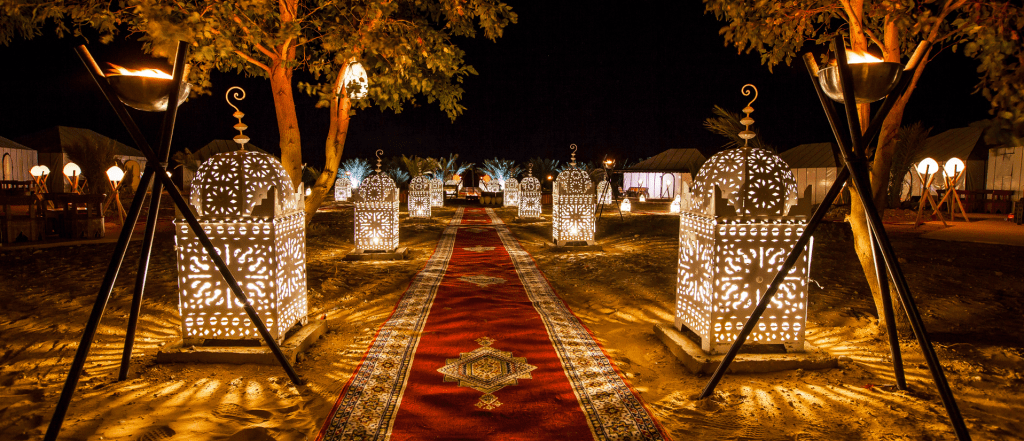
Camps range from simple Berber tents with shared bathrooms to large tents with proper beds, private bathrooms and air conditioning. The evening follows the same rhythm almost everywhere: mint tea when you arrive, dinner (often a tagine) in a big dining tent or outside, then drums around the fire and a sky with almost no light pollution.
On our tours, every camp tent has a private bathroom, and air conditioning comes with the Luxury level and above. If a quiet night matters to you, tell us when you book, as some camps sit deeper in the dunes than others. For the difference between a traditional camp and a luxury one, read Berber tents or luxury glamping, and our list of luxury desert camps in Merzouga.
Best time to visit Merzouga
The best months are October to April. Days are warm and dry and the light is soft. Within that window, March, April, October and November are the easiest, with warm afternoons and cool nights.
December to February brings sunny days around 17°C (low 60s °F), but desert nights drop close to freezing. Camps have thick blankets; bring a warm jacket and a hat anyway.
From June to August, afternoons often reach 40°C (104°F). People still come, and sunrise and sunset are lovely, but plan the camel ride for the evening and spend the middle of the day in the shade. Spring can also bring windy days that blow sand across the dunes, so pack a scarf.
For the rest of the country, see our guide to the best time to visit Morocco.
Khamlia and Gnawa music
Khamlia is a small village about 7 km south of Merzouga. Its families trace their roots to sub-Saharan Africa, and they have kept Gnawa music alive here for generations. Gnawa is a spiritual music built on the deep bass of the guembri, a three-string lute, with drums and the clatter of qraqeb, heavy iron castanets. In 2019 UNESCO added Gnawa to its list of the Intangible Cultural Heritage of Humanity.

A visit is simple and relaxed. You sit on carpets in a family house, someone brings mint tea, and the musicians play a few pieces. It is not a staged show, and leaving a contribution at the end is the custom. Our guide to traditional Moroccan music explains where Gnawa comes from.
Lake Yasmina
On the edge of the dunes near Merzouga, a shallow seasonal lake known as Lake Yasmina forms after heavy rain. For many years it was mostly a dry, cracked basin. After the rare storms of September 2024 it filled again, with the dunes reflected in the water, and people in the area said they had not seen it like that in a very long time.
When there is water, the lake draws birds, and flamingos sometimes stop on migration. When there is none, the flat basin is still a good spot for wide photos of the dunes. Whether it holds water depends on that year’s rain, so ask us before you travel. Another seasonal lake, Dayet Srji, is covered in our things to do in Merzouga guide.
What to pack for Merzouga
Pack for heat during the day and cold at night, even in spring and fall.
- Layers: a light long-sleeved shirt for the sun and a fleece or down jacket for the evening. From November to March, add a hat and gloves.
- A scarf or cheche (the local turban) for sun and blowing sand. Shops in the village sell them, and someone will always show you how to tie one.
- Sunglasses, sunscreen and lip balm. The air is very dry.
- Sandals or light sneakers for the sand. In summer the dunes get too hot for bare feet by midday.
- A small overnight bag for the camel ride, since your main luggage stays in the car.
- A headlamp or small flashlight for walking around camp at night.
- A power bank, as charging can be limited in simpler camps.
- Some cash in dirhams for tips, small purchases and the musicians in Khamlia. Small shops rarely take cards.
For the rest of your trip, our Morocco travel tips cover clothing, money and local customs.
How long to stay
One night gives you the camel ride, sunset, the camp and sunrise. Two nights let you slow down, with a whole day for Khamlia, a 4×4 loop and a rest in the afternoon heat. Coming from Marrakech, allow at least three days for the round trip, and four if you can.
- 3-Day Merzouga Desert Tour from Marrakech
- 4-Day Sahara Tour from Marrakech, with a full day around the dunes
- 5-Day Sahara Tour from Marrakech, with two nights in Merzouga
- 3-Day Merzouga Desert Tour from Fes
- All routes: private Morocco desert tours from every city
Fitting the desert into a short trip? Compare our 3-day Morocco itineraries and 5-day Morocco itineraries.
Frequently asked questions
How far is Merzouga from Marrakech?
About 560 km. That is nine to ten hours of driving, so most people split it over two days with a night in the Dades Valley or near Todra Gorge.
Can I visit Merzouga as a day trip from Fes?
Not really. It is seven to eight hours each way. Plan at least one night, ideally in a camp in the dunes.
What is the best month to visit Merzouga?
October, November, March and April are the most comfortable. Winter is fine if you pack warm clothes for the night. Summer afternoons are very hot.
Do I have to ride a camel to reach the desert camp?
No. Most camps can also be reached by 4×4. If you do ride, it takes about an hour to an hour and a half and you need no experience.
Is Merzouga a good place to go with children?
Yes. Children usually love the dunes and sandboarding. Choose a camp with private bathrooms, split the drive from Marrakech over two days, and in warm months ask for air conditioning.
Plan your private Morocco trip
Our local team plans private tours around your dates, pace and interests, with support 24/7. Explore our Morocco tour ideas or ask us to plan your trip.


